
How can data make buildings more valuable, usable and investment-ready?
Colouree is advancing its Space-as-a-Service module within the European INBLANC project and invites PropTech, real estate, ESG and finance stakeholders to share their expert feedback.
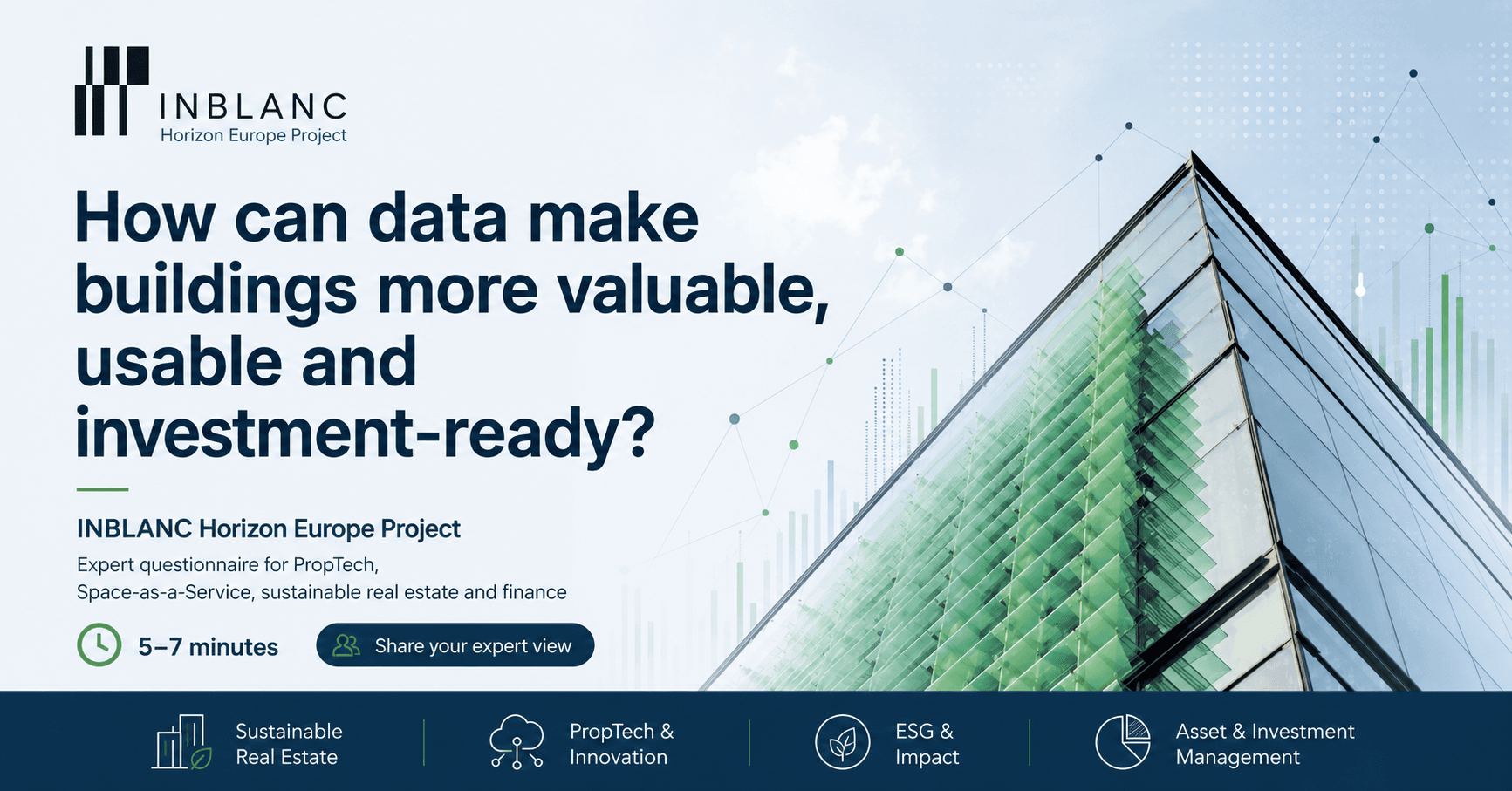
Building data already exists. Too often, however, it is fragmented, difficult to connect to decisions and underused as a source of operational, environmental and financial value.
This is the challenge behind Colouree’s work within INBLANC, a European project focused on capitalising on data across the building lifecycle.
INBLANC aims to create an open ecosystem where building data does not remain isolated information, but becomes actionable knowledge to improve sustainability, management, usability, resilience and investment readiness.
More information is available on the official INBLANC project website: https://www.inblanc-project.eu/
Why building data needs to become decision support
In real estate, decisions about a building increasingly depend on factors that go beyond technical performance alone.
Energy efficiency, comfort, user well-being, operating costs, adaptability to new uses, environmental impact, urban context and the ability to support renovation or investment strategies all matter.
The challenge is not simply to collect more data. The point is to understand which data is actually useful, how to interpret it and how to turn it into services that support decision-making.
For asset managers, property owners, facility managers, developers, investors and financial stakeholders, this means reading a building not only as a physical object, but as an asset embedded in a wider system: market dynamics, users, risks, services, urban context and ESG objectives.
Colouree’s contribution: Space-as-a-Service
Within INBLANC, Colouree is developing a Space-as-a-Service module designed to connect building data, territorial data and context indicators.
The goal is to support better-informed decisions about the use, value, transformation and positioning of real estate assets.
The module starts from a practical question:
how can data make a building more valuable, usable and investment-ready?
To answer this question, it is not enough to look at the building in isolation. Several information layers need to be connected:
- building lifecycle data;
- available technical, environmental and operational indicators;
- user needs and quality of use;
- services, accessibility and urban context;
- ESG, environmental and resilience signals, where available;
- conditions that influence management, asset attractiveness and investment scenario reading.
The module works to produce context snapshots, synthetic indicators, risk/opportunity signals and scenario readings that are useful for asset management, facility management and portfolio strategies.
This integrated view helps move from a static reading of a property to a decision-oriented one: which interventions make sense, for which users, in which context and with which potential impact.
Data, ESG and real estate finance
The transition of the building stock requires tools that connect technical information, sustainability and finance.
Buildings are increasingly assessed according to their ability to reduce risks, support ESG objectives, improve user experience and attract sustainability-oriented capital.
In this context, data can help clarify:
- where action is needed;
- which dimensions generate value;
- which risks may affect the asset;
- which opportunities emerge from the surrounding context;
- how to communicate the potential of a building to investors, managers and stakeholders.
For Colouree, this means applying context intelligence to real estate: looking not only at the building, but at the relationship between building, people, territory, market and decisions.
The stakeholder questionnaire
To make the Space-as-a-Service module more useful and closer to real market needs, Colouree invites PropTech, real estate, ESG, asset management and finance stakeholders to take part in the INBLANC questionnaire.
The questionnaire is designed to collect qualified feedback on:
- which data is most useful to assess a building;
- which indicators best support investment and management decisions;
- which digital services can create value for asset managers, owners, investors and facility managers;
- how building data, urban context and ESG objectives can be connected;
- which outputs make a tool more useful in real decision-making processes.
Stakeholder input is important because it helps orient the development towards concrete needs, relevant use cases and services that can be applied in practice.
Take part
If you work in real estate, asset management, sustainable finance, ESG, PropTech or the digital transformation of buildings, you can contribute by sharing your perspective.
Your contribution will help define tools that turn building data into stronger, more sustainable and value-oriented decisions.
Complete the INBLANC questionnaire
Help us understand which data, indicators and digital services can make buildings more valuable, usable and investment-ready.
What this activity proves
Context Intelligence for real estate decisions
This update connects INBLANC with Colouree's work on PropTech, Space-as-a-Service, sustainability and data-driven real estate decisions.
Next step
Bring Context Intelligence into your real estate decisions
Tell us what type of asset, portfolio or urban context you need to understand. We can help identify the evidence that matters first.
English edition
Explore the full Colouree website
Our English website is growing. Some projects, insights and resources are currently available only in Italian. Explore the full Italian website or contact us directly in English.